

![]() |
History : from The Risorgimento to today
The RisorgimentoAfter the napoleoic interlude (Napoleon was in Como on May.4th 1.796 and spent
the night at Villa Saporiti), during which the “Napoleona” - a route linking Como
to the Varese, Milano and Cantů crossroads - and the Teatro Sociale - a small
neoclassic temple - were built, Como was not insensitive to the European and Italian
revolutionary ferment of the first half of the 18th century. It is enough to mention
Count Luigi Porro Lambertenghi, founder of a subversive newspaper called “il Conciliatore”,
Maurizio Monti, author of a “History of Como”, which was banned because of its
progressive ideas and Cesare Cantů, who was removed from his teaching post because
of his liberal ideas. The 1.848 turning point was significant. On March.20th,
two days before the beginning of the Milan uprising, an uprising in Como forced
the Austrian garrison, headquartered in the barracks of St. Francis, to surrender.
With the defeat of Carlo Alberto, the situation was brought back to normal, in
spite of the destabilization attempts by Giuseppe Mazzini, who was then in Switzerland.
During the Second War of Independence (1.859), Giuseppe Garibaldi fought in the
outskirts of Como and after the battle at San Fermo - during which Captain Carlo
De Cristoforis died - he entered the freed city of Como, triumphant. Marquis Rovelli
had him as a guest in his palace in Piazza Volta (Volta square), where a memorial
tablet commemorates, now, this episode.
After centuries of foreign rule, our city finally became a part of the new Italian Kingdom under the Savoy. In the beginning, their rule was characterized by the resolve to equalize rights and responsibilities without emphasizing specific regional problems. At first Como was ruled by a liberal-conservative right-wing government, supported by Bishop Cesana, then, from 1.876, the left-wing governments laid emphasis on the need for social reforms. Such aspirations found expression in the words of Aristide Bari's newspaper and the deeds of Paolo Carcano which led eventually to the improvement of the workers' living conditions and facilitated the creation of new jobs. With a heightened social consciousness, we leave, behind our Risorgimento, heroes whose memory and portraits are prominently featured in the Risorgimento Museum and in Palazzo Cernezzi (the Town Hall), and turn now to the 20th century.
The 20th century
In the 20th century - aside from the sad periods of the two World Wars - Como
has been a prosperous town thanks, mainly, to the development of its dyeing and
silk industries. These activities started at the turn of the century. As a result,
a new labor force arrived in Como and lodgings were built to provide accomodation
for the workers. Antonio Sant'Elia, a victim of the First World War, was a joung
designer who signed the Furutistic Architecture Manifesto and who, with his lively
imagination, planned a futuristic town as we can see in his designs, preserved
in the Villa Olmo Museum.
Under Fascism, which imposed its own idea of culture on the whole of Italy, the
most avant-guarde architect was Giuseppe Terragni who built rationalist and extremely
practical structures (Novo Comum, Palazzo del Fascio, Sant'Elia nursery school),
in keeping with the coeval Bauhaus school in Germany, founded by Walter Gropius.
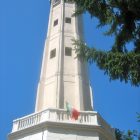
Terragni also adapted the War memorial which, as the dominating Fascist culture
demanded, was rebuilt according modified design of Sant'Elia. The Obelisk, because
of its position - standing by the lake - memorializes all those who fought, whether
on the land, in the sea or in the air. Its vertical position seems to lift the
esteemed values of patriotism towards the infinite. In the Thirties, thanks to
the efforts of artists like Mario Radice, Carla Badiali, Manlio Rho, Aldo Galli,
Como became the most important centre of Italian abstractism. Those artists, partly
following Mondrian and Kandinskij's example, by means of chromatic additions and
substractions, emphasized Terragni's style and transposed it to painting. This
is what happened in culture. What remains is the work performed by the creativeness
of all those who work in the textile and silk field. The harmony, conveyed by
the calm waters of the lake, and a sense of beauty, which emanates from the centuries-old
architectures, flows in the blood of these people.